






FMGE and NExT are licensing exams required to practice medicine in India. FMGE is currently mandatory for students who complete MBBS abroad, while NExT (National Exit Test) is expected to replace FMGE and also function as the final-year MBBS exam and PG entrance test.
Key difference: FMGE is only a screening test, whereas NExT will assess clinical skills, theoretical knowledge, and also determine postgraduate admissions.
For students planning MBBS abroad, this difference is critical because your university choice, clinical exposure, and preparation strategy will directly impact your success in these exams. In this guide, we will cover the key differences, exam pattern, eligibility, and what students should focus on to stay ahead.
What is the FMGE Exam?
An FMGE exam, or the Foreign Medical Graduate Examination, is ranked as India’s leading licensing exam for Indian citizens who have completed their MBBS degree abroad but want to practice in India. Conducted by the National Board of Examinations in Medical Sciences (NBEMS), the FMGE has been the go-to screening test for foreign medical graduates for many years.
Here’s how it works:
- Who Can Take It: Indian citizens or overseas citizens of India who earned an MBBS degree from a foreign medical university recognized by the National Medical Commission (NMC).
- Format: It is a computer-based exam that comes with 300 multiple-choice questions.
- Frequency: Held twice a year, in June and December.
- Passing Criteria: You need to score a minimum of 50% to pass the exam and obtain provisional or permanent registration with the NMC or State Medical Council.
The FMGE exam is used for testing the knowledge of students across the entire MBBS syllabus, that is, from anatomy and physiology to medicine and surgery, which means that you should prepare broadly during your MBBS years abroad.
Despite its importance, the historical pass percentage of FMGE has remained significantly lower, that is, below 30%. So, strategic preparation and early study planning are important.
What is the NExT Exam?
he NExT exam, or the National Exit Test, is a new, more comprehensive licensure framework introduced by the National Medical Commission (NMC) under the NMC Act of 2019. In the long term, NExT is all set to replace FMGE and become a common exit and licensing exam for all the MBBS graduates.
Compared to FMGE’s single computer-based MCQ exam, NExT is conducted in different parts:
- NExt Step 1: Theory-based exams with MCQs, and they are taken towards the end of your final year of MBBS.
- NExT Step 2: It is a practical and clinically based assessment that is taken after you have completed the rotating internship.
Well, NExT is designed to test not just the textbook knowledge but also clinical reasoning, patient management, and practical skills. Additionally, it also aims to streamline the medical licensing path so that the final assessment for postgraduate medical admissions and licensure will be the same examination.
FMGE vs. NExT 2026: Which Applies to MBBS Abroad Students?
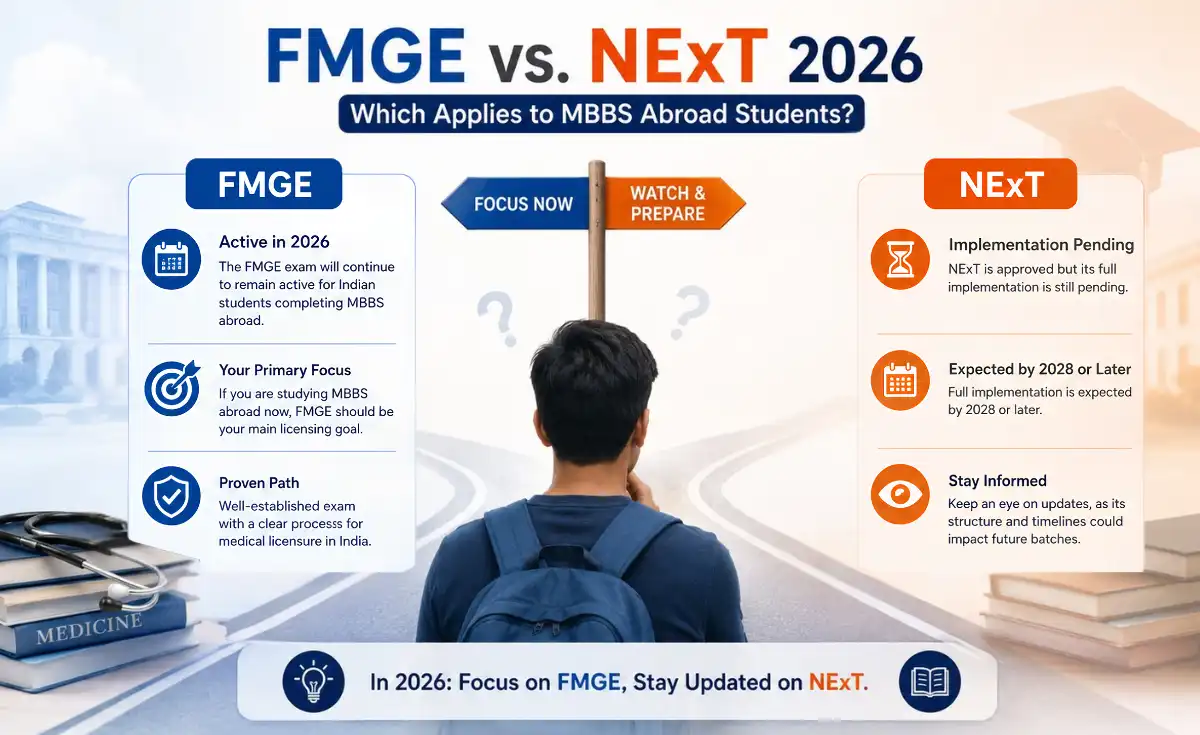
A common concern for students planning for an MBBS abroad that keeps coming up is, “Should I prepare for FMGE or NExT? The answer is simple:
- In 2026, that is, this year, the FMGE exam will continue to remain an active foreign medical licensing exam for Indian students completing their MBBS abroad.
- Although NExT has been approved and extensively discussed, its full implementation is still pending and is expected to be completed by 2028 or later.
This means:
- If you start your MBBS abroad now or are already studying, preparing with FMGE as your primary licensing exam is important.
- At the same time, keeping an eye on the developments around NExT is a wise call, as its structure and timelines could affect how future batches will qualify for licenses in India.
FMGE vs NExT 2026 Latest Updates & Timeline
The FMGE vs NExT comparison continues to be very important for Indian students pursuing MBBS abroad. As of 2026, FMGE remains the only active licensing exam for foreign medical graduates, while NExT is still under development and has not been fully implemented yet. Since NExT is also linked to postgraduate medical education, students should understand the MBBS vs MD pathway when planning their studies and future medical career.
FMGE 2026 Latest Updates
- FMGE is fully active in 2026 for foreign medical graduates
- Conducted by NBEMS (National Board of Examinations in Medical Sciences)
- Held twice a year (June and December sessions)
- FMGE June 2026 exam cycle is ongoing as per official schedule
- Admit cards and exam processes are released through the official NBEMS portal
- FMGE continues to be the mandatory licensing exam for foreign MBBS graduates in India
- Exam format remains 300 MCQs (computer-based test)
FMGE 2026 is currently the only gateway for foreign medical graduates to get a license in India. Check FMGE passing rate and preparation strategy for Indian students to better understand your chances of clearing the exam.
NExT 2026 Latest Updates
- NExT (National Exit Test) is still in the transition stage under NMC
- Introduced under the NMC Act 2019 as a future unified exam system
- Designed to replace FMGE and NEET-PG in the long term
- Will have two steps:
- Step 1 → Theory-based exam (final MBBS year)
- Step 2 → Clinical/practical exam after internship
- Full implementation is not active in 2026 yet
- Expected rollout is likely around 2028 or later (as per current updates)
Until then, FMGE remains the valid licensing exam
📌 Key Insight
FMGE = Current licensing exam for foreign MBBS graduates
NExT = Future unified licensing + PG entrance exam
👉 Students studying abroad in 2026 should focus mainly on FMGE preparation.
Eligibility Criteria for FMGE and NExT
| Feature | FMGE (Foreign Medical Graduate Examination) | NExT (National Exit Test) |
|---|---|---|
| Who can apply | Indian citizens / OCI who completed MBBS abroad | Final-year MBBS students (India + abroad in future) |
| Purpose | Licensing exam for foreign medical graduates | Common licensing + PG entrance exam |
| Degree requirement | MBBS from foreign university | MBBS from Indian or foreign university |
| University recognition | Must be NMC-approved + listed in WDOMS | Must be NMC-recognized MBBS program |
| NEET requirement | Mandatory for MBBS abroad admission | Mandatory for MBBS admission (India/abroad) |
| Exam stage | Single exam after MBBS | Step 1 (theory) + Step 2 (clinical + internship) |
| Internship requirement | Internship abroad + possible CRMI in India | Mandatory CRMI as per NMC rules |
| Eligibility timing | After completing MBBS abroad | Step 1 in final year, Step 2 after internship |
| Final purpose | Medical license in India | Medical license + PG admission (MD/MS) |
FMGE is a post-MBBS licensing exam for foreign graduates, while NExT is a future unified system for all MBBS students in India and abroad.
Why is it Important to Understand the NMC Guidelines for MBBS Abroad?
Before you commit to any foreign medical university, it is important to check the NMC guidelines for MBBS abroad carefully. These are the rules that will help in defining the validity of your foreign medical degree for licensure and practice in India.
Key parameters consist of the following:
- The university should be listed in the NMC’s approval list of foreign medical institutions. If it is not, then you might not be eligible to appear for the FMGE or NExT exam later, even after you have graduated.
- The course structure and the internship requirements should align with NMC regulations, including a mandatory rotating internship.
- You should complete both theoretical and clinical requirements as outlined by the host university and the NMC rules, or else you could face delays and even disqualification at the licensure stage.
Wrapping Up
Pursuing MBBS abroad is a big step, but the real challenge begins with understanding eligibility rules, NMC guidelines, and licensing exams like FMGE and NExT. Without proper guidance, students often feel confused about university selection, exam preparation, and future career planning.
This is where the right MBBS abroad consultant in India makes a real difference. They help you choose NMC-approved universities, explain FMGE preparation strategies, and keep you updated with the latest NExT developments. From admission to documentation and exam support, they simplify the entire process for you.
If you are planning MBBS abroad or are unsure about FMGE vs NExT, now is the right time to get expert guidance and avoid costly mistakes.

 Education