







MBBS vs MD is mainly a difference in the level of medical education. MBBS is an undergraduate medical degree, while MD is a postgraduate medical degree completed after MBBS. So, they are not two degrees that students normally choose between at the same stage.
If you are asking “Is MD higher than MBBS?”, the answer is yes. MD comes after MBBS and gives doctors advanced training in a particular medical specialty. The usual pathway is MBBS → internship → medical registration → MD/MS/DNB, depending on the career path a student chooses.
The difference between MBBS and MD can be understood through their eligibility, course duration, level of study, specialization, career scope, and salary. MBBS provides the foundation for practising medicine, while MD allows a doctor to develop deeper expertise in a chosen specialty.
This guide explains MBBS vs MD in simple terms, including the key differences, duration, eligibility, career opportunities, salary, and what students can pursue after completing MBBS.
What is MBBS?
MBBS (Bachelor of Medicine, Bachelor of Surgery) is an undergraduate medical degree that provides the foundation for becoming a doctor. Students planning to study medicine abroad can also seek guidance from an MBBS abroad consultant when comparing universities, admission requirements, and study options.
The term is derived from Latin, but in simple terms, it is the primary qualification required to practice medicine.
Key Details About MBBS
- It is an undergraduate medical degree
- Duration: 5.5 years (including internship)
- Eligibility: NEET qualification (for India and abroad)
- Career outcome: Become a general physician
MBBS builds a strong foundation in medical sciences, covering subjects like anatomy, physiology, pathology, pharmacology, and clinical practice. It is the first and most essential step in a medical career.
What is MD?
MD (Doctor of Medicine) is a postgraduate medical degree that students pursue after completing MBBS.
It focuses on specialization in a specific area of medicine and helps doctors gain advanced knowledge and clinical expertise.
Key Details About MD
- It is a postgraduate medical degree
- Duration: 3 years
- Eligibility: NEET-PG or equivalent entrance exam
- Career outcome: Become a specialist doctor
Students can specialize in fields like general medicine, pediatrics, dermatology, radiology, and more. An MD can open opportunities for specialist roles, advanced clinical practice, academic work, and career progression. Salary and career opportunities vary by specialization, experience, location, and employer.
MBBS vs MD: Key Differences
The main difference between MBBS and MD is their level and purpose. MBBS is an undergraduate medical degree, while MD is a postgraduate medical degree pursued after MBBS. In simple terms, MBBS provides the foundation for becoming a doctor, whereas MD offers advanced training in a specific medical specialty.
Here is a quick comparison of MBBS vs MD:
| Basis | MBBS | MD |
|---|---|---|
| Full Form | Bachelor of Medicine, Bachelor of Surgery | Doctor of Medicine |
| Degree Level | Undergraduate medical degree | Postgraduate medical degree |
| Comes After | Class 12 with PCB | MBBS |
| Main Purpose | To become a qualified doctor | To become a specialist doctor |
| Duration | Usually 5.5 years, including internship | Usually 3 years |
| Entrance Exam | NEET-UG | NEET-PG or applicable PG entrance |
| Career Role | General physician, medical officer, junior doctor | Specialist, consultant, academic doctor |
| Specialization | General medical training | Specific branch specialization |
| Example Branches | General medical foundation | General Medicine, Pediatrics, Dermatology, Radiology, Psychiatry |
| Career & Salary Growth | Depends on experience, role, location, and practice setting | Depends on specialization, experience, location, and practice setting |
Is MD Higher Than MBBS?
Yes, in the Indian medical education pathway, MD is higher than MBBS because MD is a postgraduate degree pursued after completing MBBS.
Think of it this way:
Class 12 → MBBS → Internship → Medical Registration → MD/MS/DNB → DM/MCh/Fellowship
MBBS provides the basic medical qualification, while MD provides postgraduate training in a medical specialty.
Can You Do an MD Without an MBBS?
In India, you cannot pursue an MD without completing an MBBS first. MD is a postgraduate medical course, so MBBS or an equivalent recognized medical qualification is required before admission.
This is one of the biggest confusions among students and parents. A Class 12 student cannot directly choose an MD in India. The correct first step is MBBS.
Career Scope After MBBS vs MD
Understanding the career paths after MBBS can help students plan whether they want to continue with postgraduate specialization or explore other medical career options.
| Basis | After MBBS | After MD |
|---|---|---|
| Career Level | Entry-level medical roles | Specialist medical roles |
| Common Roles | General physician, medical officer, junior doctor | Specialist doctor, consultant |
| Government Jobs | Government hospitals, PHCs and relevant medical recruitment exams | Specialist and other postgraduate medical roles, depending on eligibility |
| Hospital Roles | Junior/resident and medical officer roles | Specialist and consultant roles |
| Specialization | General medical training | Specialized training in a chosen branch |
| Teaching Career | Opportunities may be available depending on qualification and institution | Broader academic and teaching opportunities |
| Research Opportunities | Basic or early-career research opportunities | Advanced clinical and academic research opportunities |
| Private Practice | General medical practice, subject to applicable rules | Specialist practice, subject to applicable rules |
| Salary Growth | Varies by experience, role, location and employer | Varies by specialization, experience, location and employer |
| Further Study | MD, MS, DNB and other postgraduate options | DM, MCh, fellowship and other advanced training options |
| Career Stability | Stable career with good opportunities | Stronger long-term growth and recognition |
Salary Comparison: MBBS vs MD
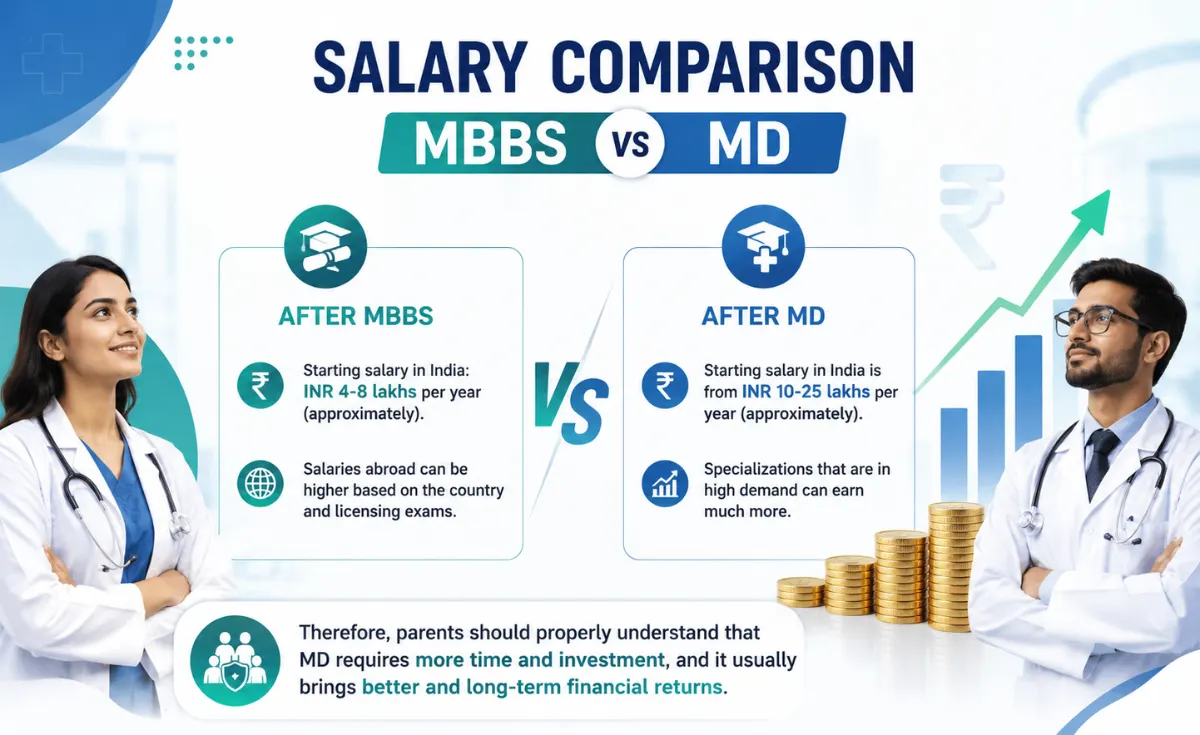
After MBBS:
- Starting salary in India: INR 4-8 lakhs per year (approximately).
- Salaries abroad can be higher based on the country and licensing exams.
After MD:
- Starting salary in India is from INR 10-25 lakhs per year (approximately).
- Specializations that are in high demand can earn much more.
MD requires additional postgraduate study after MBBS. Earnings can be higher in some specialist roles, but actual income depends on factors such as specialization, experience, location, employer, and type of practice.
MBBS vs MD: Which One Comes First?
MBBS comes first in the usual medical education pathway. Students complete their MBBS before pursuing postgraduate qualifications such as MD, MS or DNB.
- If you are just starting your medical journey, your focus should be on getting into a good MBBS program.
- If you want a higher income and specialization, you should plan for an MD after MBBS.
- You should select specialization based on your interest and not just salary.
What About Studying MBBS Abroad?
Due to limited seats and high fees in private colleges in India, many families are now exploring options abroad. That’s why choosing the right country and university becomes extremely important.
A trusted MBBS abroad consultant can guide students with:
- University recognition
- Fee structure
- Licensing exams (NExT, FMGE, USMLE, etc.)
- Admission process
- Visa and documentation
Students should also review the latest NMC rules for MBBS abroad to understand the applicable requirements before selecting a country or university.
Additionally, parents should also properly verify the credibility of the MBBS abroad consultant before making any financial commitments. Proper guidance will reduce confusion and help students make safe academic decisions.
Wrapping Up
MBBS vs MD is not really a choice between two degrees at the same stage. MBBS is the undergraduate medical degree that provides the foundation for becoming a doctor, while MD is a postgraduate qualification pursued after MBBS for advanced training in a medical specialty.
If you are starting your medical education after Class 12, MBBS comes first. After completing MBBS, internship, and the required registration process, you can consider postgraduate options such as MD, MS, or DNB based on your career goals.
The right path depends on your interests, specialization plans, budget, and long-term career goals. Understanding the difference between MBBS and MD can help you plan your medical education with greater clarity rather than viewing the two degrees as competing choices.

 Education