





What to do after MBBS or MD is one of the most searched and confusing questions for medical graduates in India. With multiple career options like postgraduate specialization (MD/MS), clinical practice, studying abroad, or non-clinical roles, choosing the right path can directly impact your future growth, income, and lifestyle.
In 2026, the competition in the medical field is higher than ever, making it important to understand which career option after MBBS or MD is best for you. Whether your goal is high salary, global exposure, or a stable career in India, the right decision starts with clear information.
In this guide, HSA EduWorld explains the top career paths after MBBS and MD, including salary, scope, and how to choose the best option based on your goals.
Career Options After MBBS MD (Salary vs Scope)
Choosing the right career after MBBS or MD depends on your goals, whether it is high salary, specialization, global exposure, or work-life balance. Here is a quick comparison of the top career options after MBBS and MD based on salary and future scope in 2026.
| Career Path | Average Salary (India) | Scope & Growth |
|---|---|---|
| MD/MS Specialization | ₹10–25 LPA+ | Best long-term growth, high demand in India and abroad |
| Clinical Practice | ₹8–20 LPA | Stable career, income increases with experience |
| Abroad (USMLE/PLAB) | ₹20–60 LPA+ | Highest earning potential, global career opportunities |
| Hospital Administration (MBA) | ₹6–15 LPA | Growing field with leadership roles in healthcare |
| Medical Research | ₹5–12 LPA | Good for academics and international exposure |
| Medical Lecturer | ₹6–14 LPA | Stable and respected teaching career |
| Non-Clinical Careers | ₹5–18 LPA | Pharma, healthcare management, flexible options |
This comparison helps you understand which career path after MBBS or MD is best based on your priorities like salary, stability, and long-term growth.
Where Can You Practice Medicine After MBBS?
After MBBS, you can practice medicine in India by clearing licensing exams like NEXT or pursue opportunities abroad through exams like USMLE or PLAB. Your eligibility depends on the country’s medical regulations and licensing requirements.
Choosing the right country to practice medicine depends on your career goals, budget, and willingness to clear required exams for global medical practice.
1. Practicing Medicine in India
- To practice medicine in India after completing an MBBS in Georgia, you must qualify for the National Exit Test (NEXT).
- Passing the NEXT exam is required to get a medical license and admission to postgraduate programs in India.
- It serves as a licensing test and a gateway to postgraduate medical studies (MD and MS).
You should also understand the difference between FMGE and NExT exams to plan your licensing journey effectivel
Steps to follow for practice medicine in India:
a) Ensure Your Eligibility for the NEXT Exam
- The MBBS course duration must be at least 54 months and include a mandatory 1-year internship.
- The entire course, training and internship or clerkship shall be done outside India in the same foreign medical institution throughout the course of study.
- Received a foreign medical degree with the medium of instruction in English.
b) Register for the NEXT Exam
NEXT exam consists of two parts:
- NEXT 1 (theory exam): Determines eligibility for licensure and postgraduate studies.
- NEXT 2 (practical exam): Assesses the applicant’s ability to practice medicine in India.
c) Obtain Your Medical License
- After successfully clearing NEXT 1 and NEXT 2, students can register with the NMC to obtain a medical license which is required to start practicing as a medical professional in India.
2. Practicing Medicine in Georgia
To practice medicine in Georgia, medical graduates must obtain a medical license from the Georgia Composite Medical Board (GCMB).
Requirements to Practice Medicine in Georgia:
a) Hold a Recognised MBBS Degree
- The degree must be from a university accredited by the National Center for Educational Quality Enhancement (NCEQE) of Georgia.
- The MBBS program must last at least six years, including theoretical studies and clinical rotations.
b) Verify and Translate Documents
- MBBS degree and transcripts must be verified by the Ministry of External Affairs (MEA) of the home country.
- All documents must be translated into English or Georgian by certified translators listed on the MCG website.
c) Pass the National Licensing Exam for Medical Graduates (NLEM)
The NLEM is a two-part computer-based exam assessing medical knowledge and skills.
Complete Residency Programs (Optional)
- Although not mandatory, completing a residency program in Georgia improves career prospects.
- Residency training helps graduates gain specialised medical expertise and secure job opportunities within the Georgian healthcare system.
Register with the Medical Council of Georgia (MCG)
- After passing the NLEM and fulfilling additional requirements, candidates must apply for registration with the MCG to obtain their medical license.
d) Additional Considerations
-
Independent Medical Practice
To practice independently, graduates may need to complete additional postgraduate qualifications, such as the National Post-Diploma Qualification Exam (NPDQE) and a residency program.
-
Language Proficiency
Although English proficiency is beneficial, candidates must be familiar with the Georgian language for effective patient interaction and clinical practice.
3. Practicing Medicine in the USA
Steps to Practice Medicine in the USA:
a) Obtain ECFMG Certification
- Ensure your medical university is listed in the World Directory of Medical Schools.
- Apply for Educational Commission for Foreign Medical Graduates (ECFMG) certification, which requires passing the United States Medical Licensing Examination (USMLE) exams.
b) Pass the USMLE Exams
The USMLE is a three-step exam program sponsored by the Federation of State Medical Boards (FSMB) and the National Board of Medical Examiners (NBME).
USMLE Step 1: Assesses foundational medical sciences and is typically taken after at least two years of medical studies.
USMLE Step 2: Clinical Knowledge (CK): Evaluates clinical knowledge and decision-making abilities.
- Clinical Skills (CS): Previously assessed practical skills, but this component has been discontinued.
USMLE Step 3: Assesses the application of clinical knowledge to patient management and is taken after completing a postgraduate training year.
c) Obtain a U.S. Visa for Medical Training
Based on your residency program, you may need to apply for a J-1 or H-1B visa to enter and train in the USA.
Apply For Residency in the USA
- Submit applications through the Electronic Residency Application Service (ERAS).
- Participate in the National Resident Matching Program (NRMP) to secure a residency position.
Obtain a State Medical License
- After completing all three steps of the USMLE, you must apply for a medical license in the state where you plan to practice.
- Each state medical board has specific licensing requirements, so ensure compliance with state regulations.
4. Practicing Medicine in the UK
To practice medicine in the United Kingdom, MBBS graduates from Georgia must register with the General Medical Council (GMC). A license to practice is required for prescribing medicines, treating patients, and working as a physician.
Steps to Practice Medicine in the UK:
a) Pass the PLAB Exams
- If you completed your MBBS outside the UK, you must pass the Professional and Linguistic Assessments Board (PLAB) exams to qualify for GMC registration.
- The PLAB exam consists of two parts:
- PLAB 1: A multiple-choice exam assessing medical knowledge.
- PLAB 2: A clinical skills assessment.
- Both exams must be passed to qualify for GMC registration.
b) Qualify for the Medical Licensing Assessment (MLA)
- Starting from 2024-2025, UK medical graduates will take the Medical Licensing Assessment (MLA) as part of their degree.
- International graduates will still take the PLAB, but it will be aligned with MLA standards.
c) Demonstrate English Language Proficiency
You must prove English proficiency through IELTS or OET as part of the GMC registration process.
Complete the Foundation Programme
After GMC registration, doctors may need to complete a two-year Foundation Programme to gain practical experience as junior doctors in the UK.
Obtain a Work Permit
Based on your nationality, you may need a work permit to practice medicine in the UK.
Additional Considerations
Continuous Professional Development (CPD): Once registered, doctors must engage in continuous training and revalidation to maintain their license to practice.
5. Practicing Medicine in Australia
To practice in Australia, MBBS graduates from Georgia must qualify for the Australian Medical Council (AMC) exams).
Steps to Practice in Australia:
- Pass the AMC multiple-choice question exam.
- Clear the AMC clinical exam.
- Apply for residency programs in Australian hospitals.
- Register with the Medical Board of Australia.
6. Practicing Medicine in Germany
Germany is an excellent option for postgraduate studies and medical practice.
Requirements to Practice in Germany:
- Learn German and obtain language certification (DSH or TestDaF).
- Enroll in pathway programs or research-based programs.
- Complete a residency program in a German hospital.
- Obtain Approbation (medical license) from German authorities.
Postgraduate Medical Studies After MBBS in Georgia
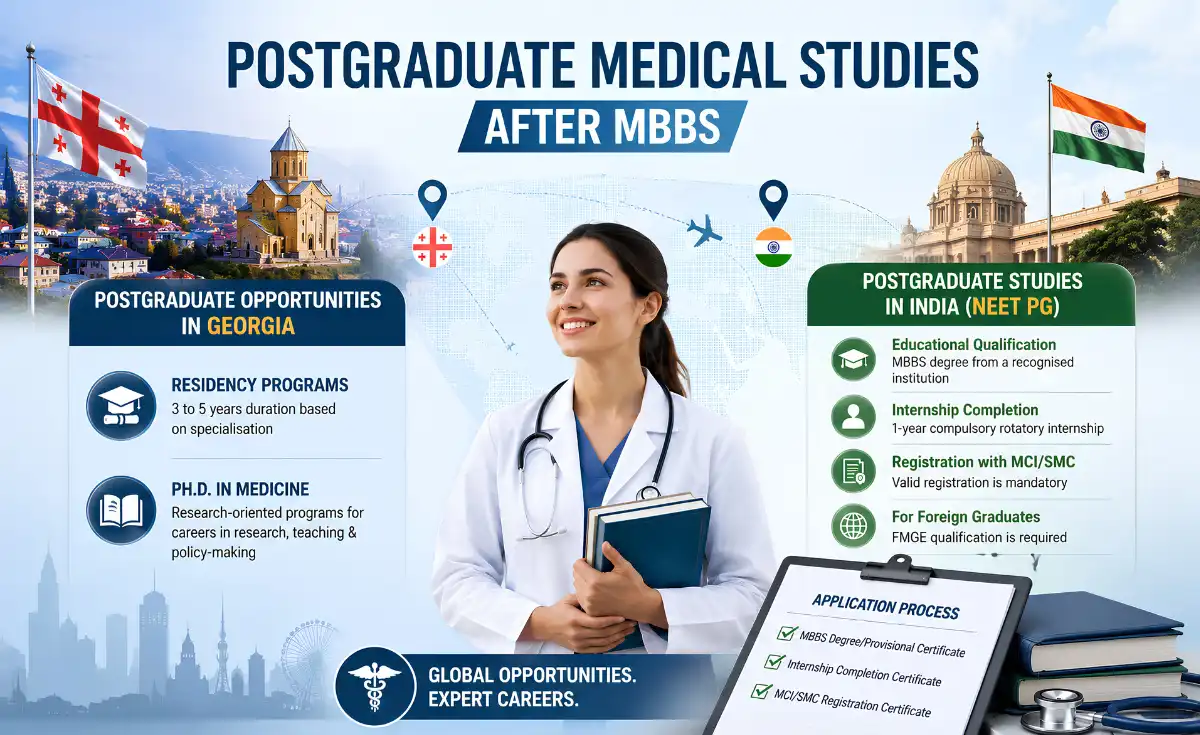
Many students choose to pursue postgraduate studies after their MBBS. Here are the countries that offer PG opportunities:
Postgraduate Opportunities in Georgia
Residency Programs
- Duration: Typically 3 to 5 years (based on specialisation).
- Eligibility: Requires passing a unified post-graduate qualification exam and meeting Ministry-set criteria.
- Institutions: Offered by University of Georgia, Caucasus International University, and other accredited institutions.
Ph.D. in Medicine
Research-Oriented programs ideal for careers in medical research, teaching, and policy-making.
Career Prospects: Leads to positions in academia, medical research institutions, and healthcare policy development.
Postgraduate Studies in India
To pursue an MD or MS in India, medical graduates must clear the NEET PG, conducted by the National Board of Examinations (NBE). The exam is mandatory for both Indian and foreign medical graduates who wish to enroll in postgraduate medical programs in India.
NEET PG Eligibility Criteria
Educational Qualification
- Candidates must hold an MBBS degree or a provisional pass certificate from a recognised institution approved by the Medical Council of India (MCI).
- For foreign medical graduates, the degree must be recognised by the relevant medical council in their home country.
Internship Completion
- A one-year compulsory rotatory internship is required. For NEET PG 2025, the internship must be completed by August 15, 2025.
- Foreign medical graduates must complete their internship as per the requirements of their home country or India.
Registration with MCI or State Medical Council (SMC)
- Candidates must have a permanent or provisional registration certificate issued by the MCI or State Medical Council (SMC).
- Foreign medical graduates must pass the FMGE (Foreign Medical Graduate Examination) before registering with the MCI.
Additional Requirements for Foreign Graduates
- FMGE Exam: All MBBS graduates from abroad must pass the FMGE to be eligible for NEET PG.
- Nationality Criteria:
- Indian citizens, NRIs, OCIs, and PIOs are eligible.
- Foreign nationals must meet specific criteria, including registration in their home country.
Application Process
- The NEET PG application is conducted online through the NBE website.
- Required documents include:
- MBBS degree or provisional certificate
- Internship completion certificate
- MCI/SMC registration certificate
Mistakes to Avoid After MBBS
Choosing the wrong career path after MBBS or MD can delay your success and reduce your earning potential. Here are the most common mistakes medical graduates should avoid:
- Lack of proper research: Many students choose a career path without understanding salary, scope, or future demand.
- Following the crowd: Selecting MD/MS or any field just because others are doing it can lead to dissatisfaction later.
- Ignoring global opportunities: Not exploring options like USMLE or PLAB can limit your career growth and income.
- Delaying decision making: Taking too much time to decide can waste valuable years after MBBS.
- Not focusing on skill development: Clinical knowledge, communication, and practical skills are equally important for success.
Avoiding these mistakes will help you make a confident and informed decision about your career after MBBS or MD.
Study MBBS Abroad with HSA EduWorld
Studying abroad and choosing to study MBBS in Georgia is a dream for many students, and HSA EduWorld helps you turn that dream into reality. As leading MBBS consultants in India, we offer expert guidance on choosing the best career path after completing your MBBS in Georgia.
Final Thoughts
Completing an MBBS in Georgia opens numerous career paths worldwide. Whether you wish to practice medicine in India, the USA, the UK, Australia, or Germany, or pursue a postgraduate degree, you must meet specific licensing and examination requirements.
Choosing the right path can be challenging, but you don’t have to do it alone. HSA EduWorld will help you get admission into the best medical universities in Georgia and guide you in your journey to study MBBS abroad and beyond. If you need expert advice, reach out to us today!

 Education